
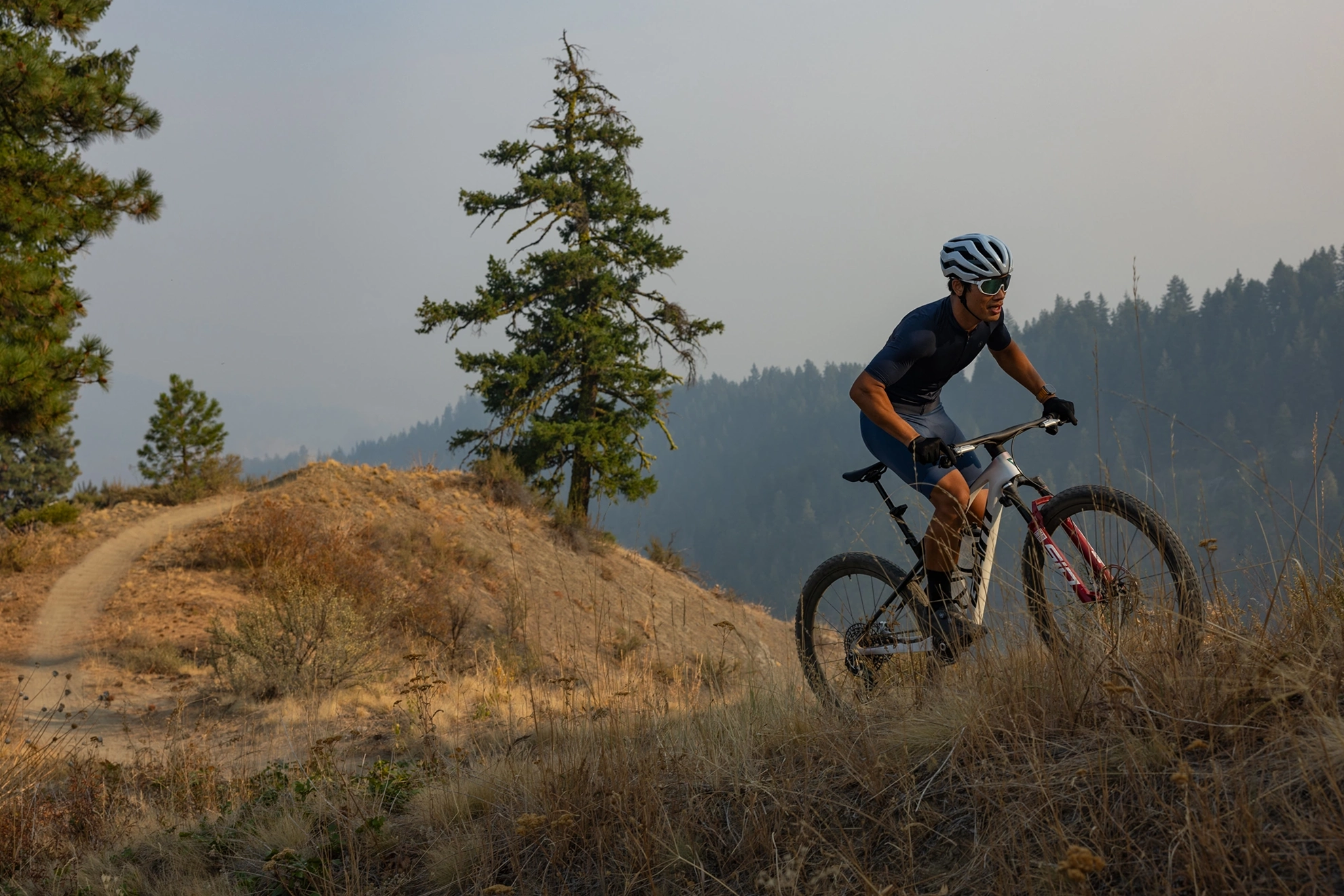
Choosing the right mountain bike can be overwhelming with so many options available. This guide simplifies the process to help you find your ideal off-road ride. The first step is understanding the two main categories: hardtail and full suspension. From there, mountain bikes generally fall into four disciplines: cross-country, trail, enduro, and downhill. We will explore the pros and cons of each to help you make the best choice.
Hardtail vs Full-Suspension Mountain Bikes
When choosing a suspension mountain bike, you will primarily decide between a hardtail and a full-suspension model. A hardtail features only front suspension, while a full-suspension bike includes both front and rear shock absorbers.

Hardtail
As the simpler and more budget-friendly of the two main mountain bike styles, hardtails feature a front suspension fork to absorb trail impacts while keeping the rear wheel rigidly connected to the frame. This design also makes them lighter than full-suspension models at a similar price point.

Full Suspension
In addition to a front fork, full suspension mountain bikes feature a rear shock that cushions the back wheel. This setup provides a smoother, faster ride over rough terrain like roots and rocks. The primary benefit is increased stability, giving you greater confidence and control on bumpy trails.
Styles of Mountain Bikes
Mountain bike disciplines are defined by terrain and suspension travel. Less travel means a lighter bike for smooth trails, while more travel suits rough terrain but adds weight. However, price also significantly impacts weight; high-end components and frames make expensive bikes much lighter than entry-level models, regardless of the discipline.

Cross Country (XC)
Cross country (XC) mountain bikes range from recreational hardtails to lightweight full-suspension race models. Featuring up to 100mm of fork travel, they are built for climbing efficiency and smooth off-road descents. Their low-profile tires make them fast on even surfaces, ideal for gravel, cycle paths, and singletrack.
Equipped with a wide gear range for steep climbs and hydraulic disc brakes for reliable stopping power, XC bikes utilise a traditional riding position with narrow bars and long stems. While this setup maximises efficiency on smooth terrain, it can feel less stable on rougher trails.

Trail
Trail bikes are a favorite among mountain biking enthusiasts. Available as hardtails or full-suspension models, they typically feature 110mm to 150mm of suspension travel. Designed for speed and confidence, they excel on descents and flowing singletrack while remaining lightweight enough for manageable climbs.
Hardtails are an excellent entry point for beginners to develop skills, offering better components than similarly priced full-suspension bikes. Conversely, full-suspension models provide a smoother ride on rough terrain.
Compared to cross-country (XC) bikes, trail bikes feature a more relaxed geometry with slacker head tube angles, wide handlebars, and short stems, delivering greater control when the terrain gets rough.

Enduro
Enduro bikes are designed for all-day riding with a strong focus on descending. Featuring 160mm to 180mm of suspension travel, they excel on the steepest and roughest terrain. While you can ride them on mellower trails, they may feel sluggish without a steep enough gradient.
These bikes are at the forefront of modern mountain bike design, featuring more relaxed geometry and slacker head angles than trail bikes. They also typically have wider fork tubes and shocks with piggy-back reservoirs and coil springs to maintain performance on rough terrain and long descents. Additionally, they come with more powerful brakes to handle steep gradients.
Although enduro bikes can be ridden uphill, trail bikes are faster climbers and generally more fun on standard trail centre tracks. An enduro bike is ideal if you frequently push your limits on challenging trails or plan to compete in enduro races. However, for most riders, a trail bike remains the better choice.

Downhill (DH)
Downhill (DH) bikes are built specifically for the steepest, roughest descents. Because they aren’t designed for climbing, you’ll need to push them uphill or use a lift. Featuring extreme geometry, about 200mm of suspension travel, and signature triple-clamp forks, these bikes offer exceptional stability on challenging terrain.
Their wheels, tires, and components are reinforced to handle intense forces, and they lack the large climbing gears found on standard mountain bikes. While perfect for bike parks and racing, they aren’t suitable for other types of riding.